
Air Duct Cleaning: Repair or Replace? How Commerce City Homeowners Decide
Most homeowners assume the answer is replace. The truth is simpler and less expensive: duct repair wins whenever the problem is isolated, and replacement only makes sense when the whole system has failed on leakage, material condition, or layout. Here’s the technical version, minus the sales pitch.
We’ve walked into plenty of Commerce City basements, attics and crawlspaces where a homeowner had already decided to rip out an entire system before anyone had even measured its leakage. Don’t replace anything until you’ve read what actually drives the decision.
If you’d rather not climb into the crawlspace or read a duct blaster printout, call (844) 625-7459.
Why Age Alone Is a Bad Replacement Trigger
A 30-year-old sheet metal duct run in solid condition often outperforms a 10-year-old flex duct install with 25% leakage. We’ve seen both firsthand. What that means: the year the house was built isn’t a decision input. The condition of the duct itself is.
Commerce City is a good place to see this play out. Homes near the original city core were built in waves, and many of those systems are older but were installed with heavier-gauge metal, tighter joints and fewer seams than some newer construction. Flex duct, by contrast, is easy to install badly. Sagging runs, crushed elbows, and joints taped once and forgotten. The age is younger, the leakage is worse.
So before you decide to replace, ask three questions:
- How much air is the system leaking? Measure, don’t guess.
- What is the material condition? Sheet metal holds up. Fiberboard and flex duct can degrade in a crawlspace or attic.
- Does the layout still serve the current room configuration? A remodel can leave returns undersized for how the house is actually used.
Any one “yes” on a problem can often be repaired. All three can move the conversation toward replacement.
When Repair Is the Right Answer
Repair is the right call whenever the damage is limited in scope and the system’s structure is sound. The most common cases we find in Commerce City:
- Isolated joint failures. Tape that’s dried out, mastic that’s failed at one connection. A single leak point is fixable.
- Localized contamination. A dump of dust or a spot of microbial growth on one section of duct is a cleaning and sanitizing job, not a replacement job.
- Physical damage from pests or impact. Rodents in one run, a ladder falling into a trunk line, something poked through the sidewall during a renovation. Repairable with a sleeve or section replacement.
- Moderate leakage with structurally sound duct. Good candidate for sealing instead of replacement.
What we look for before recommending repair: the duct is made of a material that can be cleaned (sheet metal and flex can; fiberboard that’s taken on moisture is a different story), the contamination isn’t throughout the whole run, and the layout still serves the rooms.
If you want a professional opinion on your specific system, air duct cleaning is a reasonable starting point. It gets eyes and equipment into the ducts so the condition is actually observable.
When Replacement Is the Right Answer
Replacement is the correct decision in three specific situations, and only those three. Anything else is an oversized invoice.
- Duct leakage above 20-25% of system airflow. This is measurable with a duct blaster test. It’s the piece of information a rep who walks in and shakes his head at your ductwork cannot give you. If you’re leaking more than a quarter of your air before it hits the registers, you’re heating and cooling the attic or crawlspace, not the house. Sealing can sometimes bring this down, but at the high end of the scale, replacement usually costs less than chasing leaks through a system that’s had it.
- Fiberboard duct with absorbed moisture and structural degradation. Fiberboard is essentially compressed wood fiber. Once it’s wet, it doesn’t recover. It sags, it holds odor, and it can’t be cleaned back to a sanitary state. This is the clearest case where replacement is cheaper than repair.
- A layout that no longer matches the home. Kitchen remodels move return grilles. Additions add rooms the trunk line wasn’t designed for. Basement finishes change how airflow splits. Cleaning can’t fix a layout, and neither can mastic. The system has to be re-run or re-balanced, and that’s replacement or major rework.
The consequence of skipping replacement when it’s actually the right call: you spend money cleaning a system that can’t give you clean air, and you’re doing it again next year. Repair-versus-replace, decided on real data, is how Commerce City homeowners avoid that trap.
Whether you’re headed toward repair or replacement, HVAC cleaning should happen after the ductwork is sorted out. Cleaning before the fix just contaminates the new system.
What a Duct Leakage Test Is and Why You Need One
A duct leakage test uses a calibrated fan – a duct blaster – sealed to a single register with the other registers taped off. The fan pressurizes the duct system to a known pressure, usually 25 pascals, and measures how much air has to be pushed to hold it. That number, in CFM, is your leakage. Compare it to the system airflow, and you get a leakage percentage.
Why it matters more than a visual inspection:
- Visual inspection can’t see hidden joints. The worst leaks are in the attic or crawlspace or behind drywall.
- Visual inspection can’t quantify what’s lost. A visible gap of tape might be leaking 10 CFM or 100. You need the number.
- A blaster test gives a before-and-after measure. If you seal, you can test again after and see what the intervention actually accomplished.
Our technicians use Rotobrush and Nikro equipment for the cleaning and inspection work, and Abatement Technologies air filtration systems to contain what gets dislodged while we’re in the system. Then the blaster reading tells us whether it’s time to repair, seal, or replace. That’s the data-first way to do it in Commerce City, not the gut-feel way.
Without a blaster reading, the repair-versus-replace answer is guesswork – and guessing is expensive. A visual inspection of the ductwork is fine for identifying obvious problems, but the leakage percentage is what actually decides the question. Ask any contractor you call to show you a test reading.
Commerce City’s Housing Stock Split – and What It Means for Your Ductwork
Commerce City is really two housing markets stacked on top of each other.
Original core and older neighborhoods
Homes closer to the original city core carry a mix of original and updated ductwork, and a common problem we see in these houses is an undersized return system. Returns are typically the most-neglected half of the duct system. A home built with one return path and later updated with new windows and tighter insulation often has poor static pressure because the return can’t keep up with the supply. Cleaning and sealing help; if the return is fundamentally undersized, no amount of sealing fixes it. The right call is usually a supplementary return rather than a whole-system replacement.
Reunion and newer construction
Newer construction in the Reunion area often means flex duct. Flex duct is fine when installed correctly: pulled tight, minimal sag, elbows supported, and joints mastic-sealed (not just taped). The quality problems we see are sagging runs and poor workmanship at jump ducts and returns, which adds up to real leakage without the duct looking old at all. If you’re in a newer Commerce City home and getting uneven airflow, the age of the system is the last thing we’d blame.
Both cases point to the same discipline: measure the leakage, inspect the material, then decide. For more on the full-system picture, our main page at Commerce City Air Duct Cleaning Pros walks through what comprehensive service looks like from the blower to the vent.
The Middle Ground: Duct Sealing
Duct sealing is the intervention most often skipped. It sits between “clean it and hope” and “tear it all out and start over,” and it’s the right answer for a large group of Commerce City homes.
Two approaches:
- Mastic and mesh. A technician brushes mastic onto each accessible joint and seam, using fiberglass mesh for larger gaps. Effective when the joints are exposed – in a bare basement or a spread-out attic. Labor-intensive.
- Aeroseal. A sealed system is pressurized with a fog of adhesive particles that travel through the duct and settle at the leaks, closing them from the inside. It reaches joints nobody can see behind drywall or spray foam. Best for systems with many small leaks and no structural damage.
Sealing is appropriate when leakage is moderate (think roughly 10-20%), the duct is structurally sound, and the layout delivers to the right rooms. Sealing is not appropriate when fiberboard has absorbed moisture or when leakage is so extensive that replacement is cheaper than chasing each leak. When we do a dryer vent or HVAC job, we always mention sealing as an option because it’s a simple upgrade that keeps more conditioned air where it belongs.
If any of that sounds like a call you’d have to make soon, dryer vent cleaning is a low-cost way to see the shape of your duct system before you commit to a bigger project – lint buildup is often a sign of the same problem.
When to Call a Pro
Call a professional in any of these situations:
- You see mold anywhere in the duct or around a register – don’t disturb it to investigate.
- You’ve had pest activity in the ductwork.
- You’re noticing uneven heating or cooling room to room that’s persisted through other fixes.
- You’ve recently remodeled and the rooms changed but the ductwork didn’t.
- You want an objective leakage number before deciding repair or replace.
- Your ductwork is fiberboard and has ever been wet.
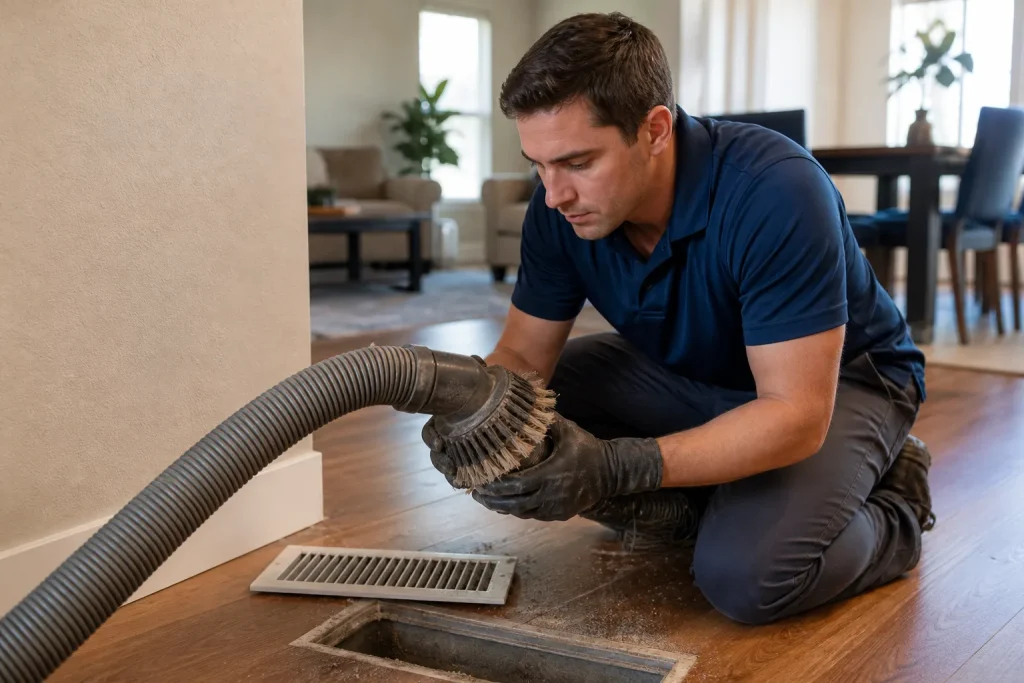
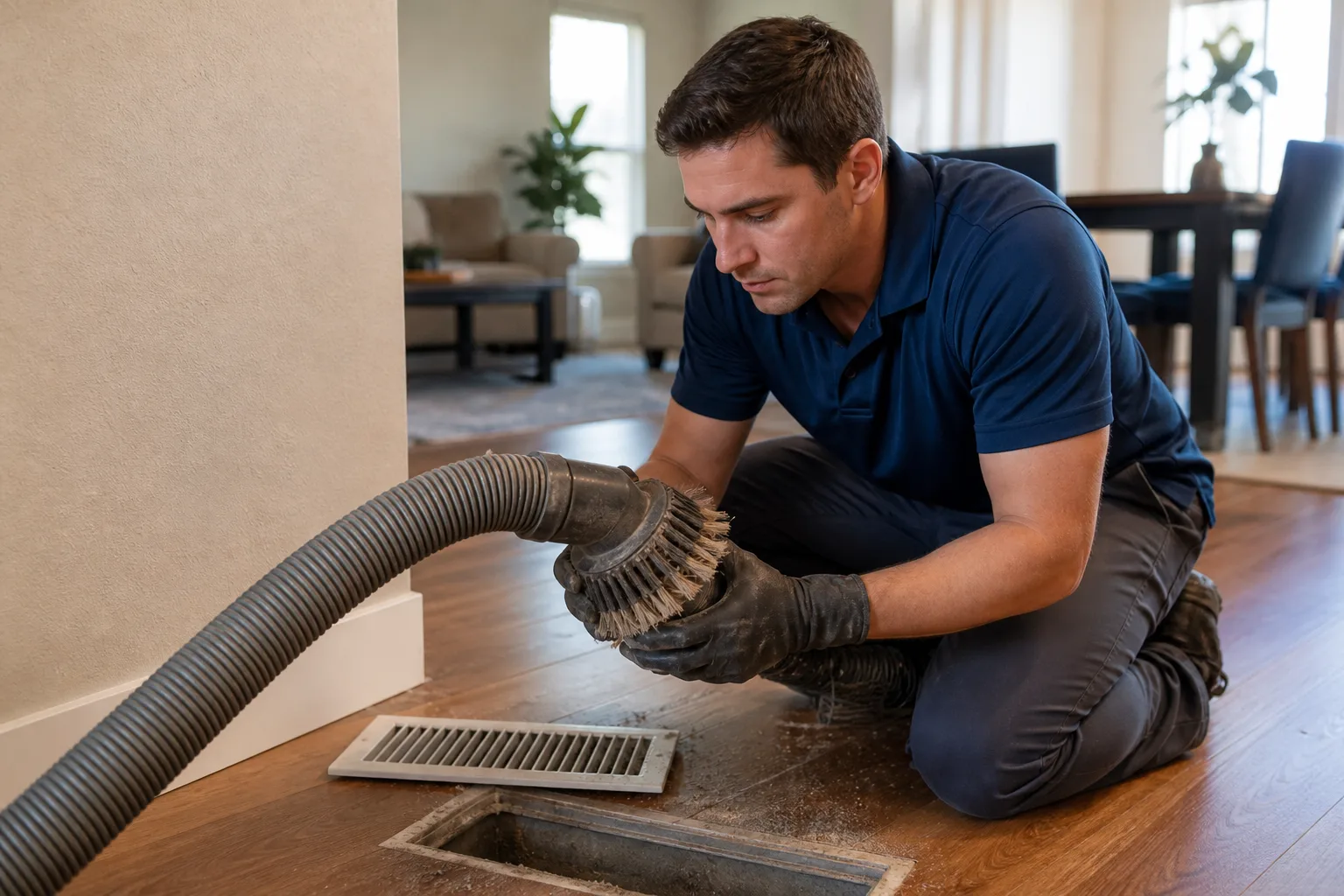
Our technicians have up to 9 years of experience and work with professional-grade Rotobrush and Nikro equipment because a shop vac doesn’t clean ductwork, it scuffs it. Then the Abatement Technologies filtration gear keeps what gets loosened from floating out of a register and into your living room. That’s the difference between professional duct work and a guy with a hose.
Related services in Commerce City
Beyond air duct cleaning, we handle duct repair and sealing, air quality sanitizing, and HVAC cleaning – so the same team that diagnoses the problem can also fix it.
The Bottom Line
Repair-versus-replace isn’t a question of age. It’s a question of three measurable things:
- Leakage rate, measured with a duct blaster. Above 20-25% and replacement becomes the cheaper long-term answer.
- Material condition, especially fiberboard that’s taken on moisture – it’s unfixable.
- Layout fit, which is about whether the ductwork matches how the house is now used, not how it was used when it was built.
For systems in between – sound structure, moderate leakage – sealing is the intervention worth trying first. For systems with isolated problems only, repair and cleaning handle it. We’ve seen all three kinds of jobs in Commerce City, and the homeowners who come out ahead are the ones who measured first and decided second.
If you’re in Commerce City and want a real answer instead of a sales pitch, Commerce City Air Duct Cleaning Pros offers free estimates – call (844) 625-7459. We answer 24/7. Fast dispatch from 7am to 7pm, Sunday through Friday.
Frequently Asked Questions
Get a duct leakage test. If leakage is above 20-25% of system airflow, or if the ductwork is fiberboard that has absorbed moisture, or if the layout no longer matches the home after a remodel, replacement is usually the right call. If the problems are isolated, repair and sealing handle it. A blaster reading is the objective starting point. Call (844) 625-7459 for a free estimate on testing and inspection.
Yes, in most cases. Joint failures, localized contamination, and single-section damage from pests or impact are all repairable. The exceptions are fiberboard that’s structurally degraded from moisture and systems with widespread leakage. A blaster test tells you which category you’re in.
It measures the amount of air escaping the duct system at a specific test pressure, compared to the total airflow the system is moving. The result is a leakage percentage. Above 20-25% and the system is losing too much conditioned air before it reaches your rooms. It’s more reliable than a visual inspection because the worst leaks are often hidden.
Yes, when the duct is structurally sound and leakage is moderate. Mastic sealing handles accessible joints, and Aeroseal reaches joints hidden behind walls. If the ductwork is fiberboard that has absorbed moisture, sealing won’t help and replacement is the answer. Call (844) 625-7459 for a free estimate on sealing.
Written by the team at Commerce City Air Duct Cleaning Pros.
Need Air Duct Cleaning Help?
Call Commerce City Air Duct Cleaning Pros - the local pro we connect you with is licensed and insured, here with fast help in Commerce City.
(844) 625-7459